
CEU TRAINING: EFT in Infidelity Recovery
DATE: 01-26-2022
TIME: 11:00-1:00 CST
OUTSIDE STUDY: 1 hour
DIDACTIC PRESENTATION: 2 hours
EDUCATOR: Tara Riggs, MT 3969
SOURCES: Restoring Broken Bonds Live EFT Training and Materials, EFT AIRM (Attachment Injury Repair Model) Training & Materials
Introduction
As you learned a few months ago, engaging grief is an essential component to helping individuals and couples heal from the emotional and relational trauma of infidelity. Shaun Lotter, in this previous didactic, paved the road for where couples need to go and even laid out a progression for how to help them grieve individually, in the presence of one another, and eventually together, in a way that leads to a thorough and complete healing of the injury. In this didactic, you will learn HOW to get to where you want to go using the EFT Tango as your mode of transportation.
How is couples counseling different in Infidelity Recovery?
According to Susan Johnson, the following are key differences in working with traumatized couples, namely those dealing with the trauma of infidelity:
- More distress and intense cycles of distance, defense and distrust.
- Psycho-education regarding trauma and how it impacts victim’s responses is necessary.
- Violence and substance abuse are more endemic.
- Alliance is always fragile, monitor it. Collaboration and transparency are essential.
- Emotional storms and crises must be expected.
- Emotion must be contained as well as heightened. Defenses are validated.
- Shame overrides even positive cues. Addressing model of self is crucial.
- Need to co-ordinate with other therapies.
- Safety is everything, risks must be sliced thin and supported at each step.
Role of the Therapist in Infidelity Recovery
This data has several implications for us as therapists in helping couples heal and creating an environment in which safety is foremost. It is vital that the work be slow and thin. Expect to work with defenses in both partners. Both have good reasons to not want to feel; the betraying is fighting off the guilt, shame, disgust, and grief of their own actions which cause him/her to avoid and run from the pain in their partner; the Betrayed would much rather feel anger and disgust toward their partner or be fully through the process of forgiveness and reconciliation, than touch the pain of utter wreckage within themselves. And each time this pain is touched, despite their best efforts to avoid it, their partner is seen as the enemy and the one who caused it or they are forced to contain the enormous emotions within. Therefore, you must be fully with each client as you work with them, supporting each step into the ocean of pain that sits just beneath the surface, going on ahead and inviting them in as you safely contain it. Imagine giving swimming lessons to a drowning victim after the incident. Feel into the victim’s experience within yourself. Imagine the terror, pain, and trauma brought on by the sensation of water against their skin and the sight of the lake in view. This is what the spouses carry into the room each time they come to counseling, except that in the couple session sits the person who took their floatation device and left them to drown. Your role is that of the swim instructor and lifeguard in that scenario. Attunement to each spouse, confidence in yourself and your process, and caution and pacing to the readiness of the clients are all pieces that you will attend to in every infidelity session with every couple. Normalize the PTSD-like symptoms in the Betrayed spouse such as intrusive memories of the event, vigilance and hyperarousal associated with a fear of potential future emotional injuries, shattering of basic beliefs about self, partner, and relationship (Johnson, 2002). Once defenses are navigated, there is not much need for emotional heightening, as the pain is alive and acute. Instead, contain the pain by touching it and offering yourself as a support to be with it and make space for it, and once it is safe, utilize the partner to help carry the pain.
Goals for Resolving the Injury
In the context of a relationship offering a safe haven and secure base…
- Regulate and integrate emotional experiences related to the injury event.
- Create secure connections of repair, restitution and belonging leading to healing and recovery.
- Construct a coherent narrative as meaning, impact, and consequences of the event emerge.
How the EFT Tango Evolves Across the Course of Infidelity Recovery
Refer to the figure below for a visual representation of the course of treatment over time. The task of the therapist changes with each layer of the pyramid, as well as how the task is accomplished.
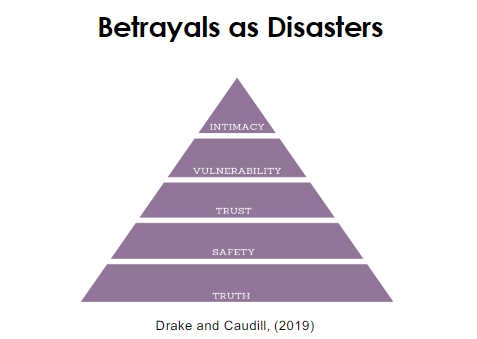
- See EFT AIRM De-escalation Roadmap for a guide to helping couples create a coherent narrative of the infidelity and achieve de-escalation (Stage 1, Steps 1-4).
- See Steps and Interventions of AIRM (Attachment-Injury Resolution Model of EFT) for a breakdown of therapist’s tasks and interventions for achieving each task over the course of therapy.
- Definitions of EFT Interventions in resource above. (See pages 67-72 of Attachment Theory in Practice by Susan M. Johnson for further explanation of general experiential techniques.)
- Empathic Reflection- Intervention used during the therapeutic process when you repeat back to the client the “felt sense” or embodied experience of what they are presenting-using wording, affect, tone, energy, metaphor, etc. (“Brain Sync -Sharing” technique for “Naming Feelings” in NICC)
- Validation- Therapist intervention that honors or affirms the function of a person’s behavior in their struggle, protection, attempt to grow, etc fostering a sense of safety in therapy session. i.e. find the “good reasons” behind the behavior, usually referring to protective action.
- Reframing in the context of the cycle and/or underlying attachment fears, pain, needs.
- Empathic Conjecture– When a therapist tentatively offers emotional words or phrases to clients to expand their emotional experience (“Brain Sync- Sharing” technique for “Naming Feelings” in NICC)
- Heightening– deepening engagement with inner experience using RISSSC voice (repetition, imagery, slow, soft, simple, client’s words)
- Evocative Responding– technique for heightening using questions and statements which elicit underlying emotions, thoughts, perceptions, sensations.
- Restructuring and shaping Enactments (aka “Encounters”)- The sharing of intensified, distilled, core emotion from one partner to another, used to pinpoint problematic interactional responses, to exemplify new responses, to turn an emerging emotional experience into a new signal to potentially evoke new responses. (“Enacting Mismatch” in NICC)
The EFT Tango is the vehicle we use to help couples move through the acute distress of discovery and disclosure to the healing and recovery of a safe haven and secure base. It is within this Tango that couples feel into their grief, anger, and other intense, unprocessed emotional pain, and incrementally share this pain, first with the therapist, then with their partner.
Early in the work of Infidelity Recovery, (Steps 1 & 2) the couple is in acute distress and the pain is alive, so the focus of therapy is on the Impact of the Injury. Due to the intensity of the attachment distress, early coping strategies will come online and organize the clients behavior, and if/when they are unable to access their partner, secondary strategies will form. In other words, spouses often feel crazy for the things they are doing and saying and feel very unlike themselves, and this disorientation leads to shame and a shaken sense of self. Psycho-education is used as a form of validation and to normalize behavior and neutralize shame. The EFT Tango is used as a method of co-regulation with the therapist. Reflecting and validating secondary emotional experiences will be a large portion of the work. The client needs to feel understood, heard, and seen in their anger, frustration, disgust, etc. The Betrayed spouse is given permission to mistrust the Betraying partner’s account and we invite them to give permission to their anxiety to exist. As individual sessions prepare for disclosure, the couples sessions privilege the injury and the work becomes managing the bleed out, i.e. triggers, boundaries, etc. which we call Stabilization and the training materials call “Triage.” For the Betraying spouse, there are enormous feelings of guilt, shame, fear, and grief which may or may not be being defended against with minimizing, blame shifting, etc. Individual sessions leading up to Disclosure (and following it when necessary) should be used to work with these defenses, using empathy and bypassing, and access underlying core emotion in order to ensure that the Betraying partner is safe to be in session with the Betrayed partner. Relentless empathy for both partners is imperitive here, as the coping with the attachment injury takes control of their dance/cycle.
Steps 3 & 4- Meaning of the Injury- By now, each partner has had experiences of “feeling felt” by you; you have allowed them to feel understood, validated, and normal for their responses, which has proven you worthy of trust and able to be taken in as an internal resource. The work of infidelity recovery cannot move forward until this has happened. As this happens, defenses soften, and attachment fears and longings will come on line, giving way to the grief of what has been lost and the shaken view of self, view of other, and view of the world and the Betrayed spouse begins the process of making meaning of the injury. Your support is what allows both the Betrayed and Betraying spouses to stay in contact with the pain of the injury, with it’s impact, and tolerate it to completion. The Betrayed spouse will begin to get a sense that the wound is within themselves and the person who caused it is their spouse, but the spouse is not the wound. Help the Betraying partner to use emotion words about themselves, such as angry, hurt, sad, etc. not those that reflect on the partner, such as unloved, uncared for, etc. As the Betraying partner becomes less defended, they are more aware of the impact of the event on their partner, and more able to discuss how it evolved without ambiguity or hiding and with more openness, becoming predictable to the Betrayed spouse and beginning the process of rebuilding trust. The couple is able to explore and understand the pre-injury pattern of disconnection which made the relationship vulnerable to infidelity.
Markers for end of Stage 1:
- Betraying partner can feel into the experience of the Betrayed, including impact and meaning of the injury, as well as their own pain.
In Steps 5 & 6, therapy begins to move into the Forgiveness and Reconciliation Stage (Stage 2) . Due to repeated successful experiences of feeling into their pain with you co-regulating their painful emotions, widening their window of tolerance, the Betrayed partner is now able to articulate their grief, distrust and fear directly to their spouse in enactments/encounters and allow him/her to witness their vulnerability. He or she also begins to ask for needs to be met that would regain feelings of trust, safety, and connection. As the Betraying partner becomes more open to and able to tolerate their own fear, guilt, and sadness caused by their actions, they also become more emotionally accessible, responsive, and engaged (ARE) to their partner by responding with remorse, regret, and empathy. He or she mirrors the pain of their spouse in themselves and feels into their spouse’s pain without defense and stays present without collapsing into shame, vowing that this will never happen again. There is also a shifting into being able to forgive themselves whereas previously they have a sense internally, even if not spoken, of the impossibility and even wrongness of ever forgiving themselves. If they cannot forgive themselves they cannot fully feel into their partner’s forgiveness, and this maintains distance between the couple.
Markers for end of Stage 2:
- Conversations about injury are less rigid and pain is less acute
- Injury feels like it is behind them
- Couple engages conversations that were previously avoided
- Feelings of loss, fear, remorse, and pain are processed
- Withdrawer is ready to be re-engaged
Step 7 & 8 make up the Consolidation Stage in which the Betrayed partner is able to ask for and receive/accept the care and comfort of the Betraying spouse AND show empathy for the Betraying partner’s experience. The Betraying partner responds with care and selflessness which acts as antidote for trauma and redefines relationship as a safe haven. Therapist underscores, highlights, and heightens this bonding event as an antidote and the relationship as potential safe haven and supports the new narrative of the event. The couple’s connections become more centered around their personhood, genuinely knowing and holding one another, not about the injury. The injury had been the rallying point, now the strenghth and draw of the relationship is the rally point.
During our time together in Team Meeting, we will watch and talk through video of my work with couples at various steps and stages and how the Tango looks different throughout to see the skills and strategies in action. I look forward to learning together!