
Dec. 1 Life @ MCO Report
MCO Wellness Advocate Program:
Help those you care about connect with the care they need!
We are so excited to launch the MCO Wellness Advocate Program. As a member of the MCO Wellness Advocate Program, you can help advocate for the importance of mental, emotional, relational, and spiritual wellness, and spread the word about the professional care that MyCounselor provides.
Each person you refer will receive a discount on their first session and, as a thank you, you will receive a $25 gift card of your choice!
The MCO Wellness Advocate Program is a community of people who believe in the importance of biblically integrated and clinically informed Christian Counseling who want to help others connect with counseling that really works! Watch the video below to learn more.
Learn More & Become an Advocate: https://mycounselor.
Clients Loving on our Clinicians
- Emily Hurst: Emily is warm and doesn’t make talking about sex therapy awkward at all!
- Lane: We love our sessions with Lane. He is insightful and helpful in getting us to communicate better and really express our feelings to one another. He has been especially helpful to me in that he provides the intellectual rigor (the “why”) behind what he says. We rely on his training and experience to help us recover and strengthen our marriage. Thank you, Lane!
- Melanie: I have been seeing Melanie for over a year and a half. She is kind and honest. She had been extremely helpful.
- Alyssa: Alyssa has been a big help to my depression and trauma. It has been my first experience with counseling and she has been wonderful.
- Melissa: Honestly, I’m having a hard time with my faith, but I feel like almost every session is definitely spirit led and exactly what I need.
December Birthdays
Danielle Schaefer: December 1st

“Danielle, you are a beautiful person that deserves the best of birthdays! I hope your day is filled with much love and fun, making you feel extra special! Your gentleness, sweet spirit and wisdom is such a gift to our clients and the MCO team. Enjoy your special day and an even better year”! Rosie
Tina Mendeleyev – December 8th

“A very Happy Birthday to you, Tina! It has been a gift to work with you and I feel blessed to have gotten to know you a little more over these last couple of months. I truly appreciate just how much you do for us in AR and with insurance billing. I hope this next year brings you immeasurable joy”! ~ Samantha
Josh Spurlock – December 24th

“Josh-Happy Birthday! You are such an amazing leader and friend. I feel so blessed to have had the opportunity over the years to know and work with you. I am praying you are blessed on your birthday! Take time to enjoy something you like with your family! Here’s to another great year!” ~Shaun
William Woodward – December 27th

“William, hoping you have a fun and memorable birthday surrounded by the ones you love and lots of cake! We are so grateful to have you on the MCO team and hope this year is better than the last. Happy Birthday!” ~ Rosie
Leona Scifres – December 31st

“Leona, You are such a light! It has been my pleasure getting to know you the last few months. I will always remember our laughter and friendship bonding on the cruise and how you can make anyone feel welcomed and loved! You have a heart of GOLD! I hope you have a wonderful Birthday and a fabulous year!!! I hope you get all the puppy kisses from Goose and get to celebrate with good friends and drinks! Cheers! Hugs, and lots of Love, Ryenn”
Prayer Requests
Lacey– family is in need of your prayers. Our 8 y/o grandson, Jensen Lee has just been diagnosed with Leukemia. We are in shock and trying to get our kids everything they need before they head to St Jude’s today. Please pray for our sweet boy as he has to walk this journey. Please pray for our son and his wife as no parent is ever prepared for this. Please pray for us as our grandparent and parent hearts are breaking as our kids hurt.
Fun Fact about September!

From May thru October when I am not working, you can find me and my family boating on Tablerock Lake in Branson. My husband is an avid slalom skier, and I recently learned to water ski a couple summers ago. My goal next summer is to learn to slalom. We will see how it goes! Our favorite days are our family days on the lake!
Didactic Materials
Clients will come to us and present with inhibited sexual desire and might have trouble with arousal as well. However, not every inhibited sexual desire means that there is a struggle with arousal. But if there is a struggle with arousal, there probably is an inhibited sexual desire. It is important for us to be able to know the difference between sexual desire disorders and arousal disorders. The DSM-V has combined the two.
DSM criterion –
- Female Sexual Interest/Arousal Disorder
- Lack of, or significantly reduced, sexual interest, as manifested by at least three of the following:
- Absent/reduced interest in sexual activity
- Absent/reduced sexual/erotic thoughts or fantasies
- Absent/reduced sexual excitement/pleasure during sexual activity
- No/reduced initiation of sexual activity
- Absent/reduced sexual interest in response to any internal or external sexual/erotic cues (written, verbal, or visual)
- Absent/reduced genital or non–genital sensations during sexual activity
- Symptoms have persisted for at least 6 months
- Symptoms cause clinically significant distress in the individual
- Sexual dysfunction is not better explained by a nonsexual mental disorder or as a consequence of severe relationship distress or other stressors or substance/medication or other medical issues.
- Specify whether:
- Lifelong
- Acquired
- Specify whether:
- Generalized
- Situational
- Specify current severity
- Mild
- Moderate
- Severe
- Lack of, or significantly reduced, sexual interest, as manifested by at least three of the following:
- Male Hypoactive Sexual desire disorder
- Persistently or recurrently deficient sexual/erotic thoughts or fantasies and desire for sexual activity.
- Symptoms have persisted for at least 6 months
- Symptoms cause clinically significant distress in the individual
- Sexual dysfunction is not better explained by a nonsexual mental disorder or as a consequence of severe relationship distress or other stressors or substance/medication or other medical issues.
- Specify whether:
- Lifelong
- Acquired
- Specify whether:
- Generalized
- Situational
- Specify current severity
- Mild
- Moderate
- Severe
Master’s & Johnson Sexual Response Cycle
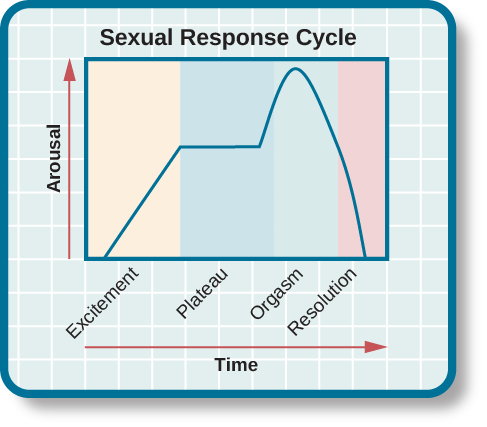
DESIRE
“Inhibited sexual desires is a disorder of the appetitive, or pre-excitement, phase of the sexual response cycle. Both the desires and mental images for sexual activity may be impaired. The urge to be physically close, to be touched, to be aroused, and to have release is in some way inhibited so that the person is not drawn to his or her spouse.
Some people with inhibited sexual desire are not aware of any sexual feelings at all, not even a flickering, it would not be a problem if there is no possibility for future sexual activity. Others masturbate but have no desire for the intimacy of sex with their spouse. Still others only feel sexual desire for someone they cannot have or someone who is destructive for them. And then there are those that feel sexual urges for their spouse, but only when there is no possibility on acting on those urges.
The sexual drive can be totally blocked, or it can be misdirected. Many times there is a barrier that keeps sexual energy from being expressed or being experienced in the marriage relationship.
Although we are all born with a sex drive, about 40% of the sexual therapy clients report disorders of sexual desire. Men, as well as women, experience loss of desire. Problems of desire are usually deeper, more resistant problems than the dilemmas of the sexual response cycle. “- Penner’s Counseling for Sexual Disorders
Things we hear wives say for desire issues:
- If I never had sex again I’d be fine
- Why can’t we just connect emotionally
- Sex is just for men
- It’s my job/ my wifely duty
- I’m not a sexual person
- My husband is a pervert
- I’m grossed out by his arousal or sex
- Sex is messy
- It takes too much effort
- I don’t have sexual thoughts/I don’t ever think about it
- I feel normal- that no wife they know wants sex
- My body just doesn’t work
Triage for trauma (sexual, betrayal), relational distress, pain
Female Desire Problems
– Relationship Issues: unresolved marital conflict often lead to sexual intimacy issues
- The underlying stress in the relationship must be resolved before anticipation of sexual activity with husband can be elicited – Penner’s
– Unsatisfactory sexual response: if wife struggles becoming aroused or being orgasmic, her desire for sexual intimacy will decrease (unrealistic expectations, delayed consummation)
– Sexual conflict: inability to accept her sexuality
- When women experience conflict about being sexual, it may be because rigid anti-sexual teaching, pass sexual trauma, or ambivalence about being out of control and vulnerable with a man- Penner’s
- – Rigid Anti-Sexual Teaching: most often associated with religion, where women aren’t given permission to enjoy and express their sexuality or receive sexual pleasure (purity culture, extreme modesty teaching, abstinence curriculum, scare tactics, loud silences around sexuality, etc.)
- – Sexual trauma: Many adult women have had at least one sexual experience that left them confused, guilty or traumatized. They usually blame themselves for these events, and thus feel badly about themselves sexually -Penner’s (Molestation, Incest, assault, early exposure to sexually explicit content, guilt about masturbating or fantasizing, etc.)
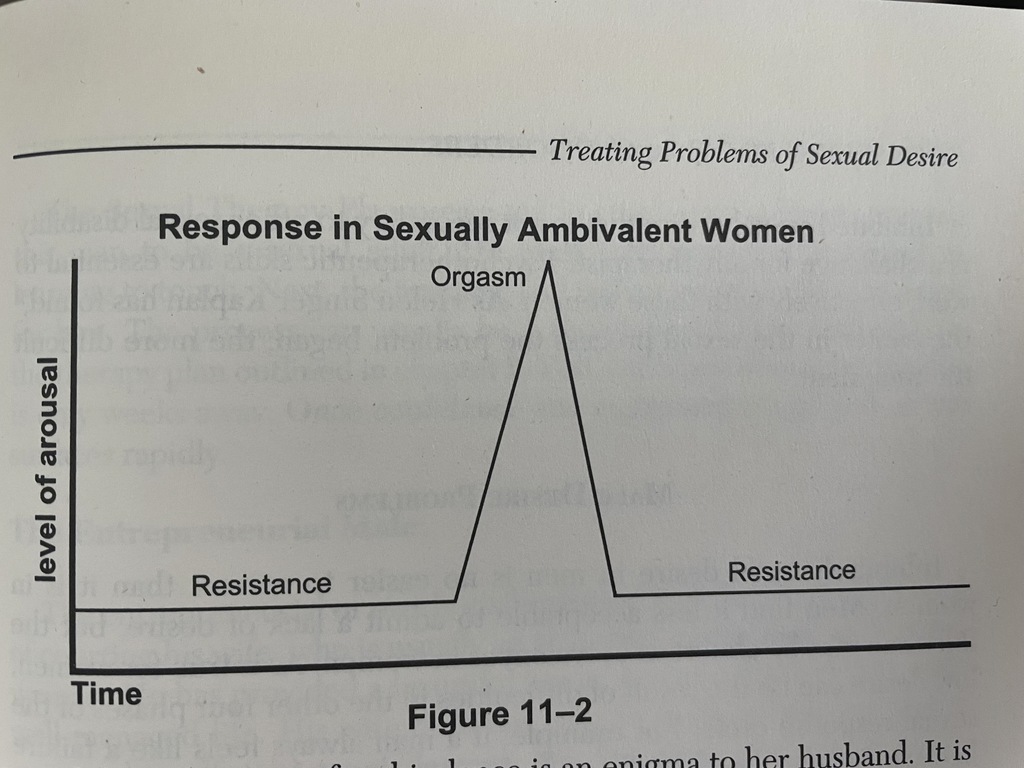
- – Sexual ambivalence: this is a persistent avoidance of sex, these women often come from chaotic, dysfunctional homes. Their bodies may respond sexually, however, pre and post times of sexual intimacy anything sexual is aggressively avoided or can be experienced as dormant. Sexual ambivalence can be challenging for husbands to understand because their wive’s bodies respond well during intercourse.
Male Desire Problems
Inhibited sexual desire problems in men is no easier to correct than it is in women. Men find it less acceptable to admit a lack of desire, but the dilemma may be almost as prevalent as in women. – Penner’s
– Sexually Naive Male: little to no experience, underdeveloped in emotional expression, feelings of inadequacy (respond very well to education)
– Entrepreneurial Male: Goal oriented and does not prioritize sex
– Emotional-Sexual Blocks:
- – Lack of bonding in infancy: Decrease or absence of bonding in infancy can lead to a fear of expressing and receiving intimacy
- – Sexual trauma: Negative feelings associated with themselves and sexuality, guilt/shame/humiliation for example (effects men in the same way it effects women)
- – Rigid Anti-Sexual Teaching: most often associated with religion, where men aren’t given permission to enjoy and express their sexuality or receive sexual pleasure (purity culture, extreme modesty teaching, abstinence curriculum, scare tactics, loud silences around sexuality, etc.)
- – Controlling, male deprecating mother: “If a boy grew up in a home with a mother that totally usurped any of his sense of power and independence as he was developing, he will be very hesitant to allow himself to be open and vulnerable with a woman. Having sex with his wife may elicit an overwhelming sense of panic at being swallowed up or being controlled.” -Penner’s
- – Homosexually Oriented Male: if a man is attracted to men, even if never expressed, will make it difficult for him to respond positively to sex with a women or his wife (this is not our area of expertise and would likely need to refer)
External Factors that Affect Men & Women Sexual Desire
– Illness/Medication Side Effects
– Addiction
– Menopause or Hormone Imbalance
– Surgery or Childbirth
*It is always wise to rule out external factors through a physical exam with a physician
AROUSAL
Sexual desire in marriage usually leads to the initiation of sexual activities that stimulate sexual excitement or arousal. Failure of the natural, involuntary bodily response of sexual excitement, is usually due to anxiety, although physical, medical causes should be ruled out before assuming an emotional basis- Penner’s
Things we hear wives say when it’s strictly arousal- frustration with their body
- It takes too long to get there
- My mind is always distracted
- I don’t know what feels good
- It’s embarrassing to say what feels good
- My desire/excitement build with no orgasm
- My orgasms are weak (if at all)
- I used to be able to orgasm, why can’t I now
Problems of Arousal for Women
– Lack of feelings of arousal: Inhibited sexual excitement for women, once negatively labeled frigidity, is usually experiential, not actual. In other words, the women’s body is responding with vaginal lubrication, nipple erection, and initial engorgement; however, she does not subjectively feel aroused. Her emotions are not connected with her involuntary bodily responses. These women who lack the feelings of arousal are mentally disconnecting themselves from their bodies. They have not programmed themselves to be sexual persons or to enjoy the giving and receiving of sexual pleasure. They see sex as a duty they perform to keep their husband happy and themselves from feeling guilty.- Penner’s
- Something in the past has made it difficult to make a positive association with sexuality and themselves. They must learn how to give themselves permission to be sexual, connect sexual feelings to somatic experience, remove pressure to please, and learn to respond to their bodies and pursue sexual pleasure so that arousal can be achieved.
– Lack of vaginal lubrication and engorgement: In women, this actual lack of physical arousal is rare, probably because women tend to be more passive sexually and arousal is a passive, parasympathetic nervous system response. The emotion of anxiety can, however, interrupt or prevent arousal for women. The sympathetic nervous system becomes dominant because of anxiety and interferes with the involuntary parasympathetic nervous system response. – Penner’s
- – Lack of understanding of how to properly stimulate her body to arousal by herself and her husband. Unfortunately female arousal is more complicated than male arousal and is not often pursued as a priority. And when properly stimulated is discovered, her body will respond.
Problems of Arousal for Men
-Erectile Dysfunction: a man’s inability to achieve or maintain an erection.
- – Causes of Erectile Dysfunction:
- – Anxiety: performance fear due to a past experience and preoccupation with recurrence, or another new negative experience. Anxiety increases with each failure.
- Negative experiences– premature or delay ejaculation, fear of rejection, etc.
- – Physical Factors: erection is a vascular response, so any type of blood flow issues can cause ED, hormonal imbalances, diabetes, medication side effects, addiction, smoking.
- – Anxiety: performance fear due to a past experience and preoccupation with recurrence, or another new negative experience. Anxiety increases with each failure.
TREATMENT
Restoring the Pleasure Assignments broken down into subsection and the purpose within each section
Phase 1– undoing the trauma of awkward sex and establishing intimacy
- Assignments 1-10
Phase 2– education, rebuilding sexual selves
- Assignments 11-23
Phase 3 – pairing positive sexual feelings with safe sexual experiences
- assignments 24-end
- *** Anorgasmia or Pain protocols will be added at the very beginning of third section
CLINICIAN RESOURCE (all Penner quotes were pulled from this source for today’s training)
Counseling for Sexual Disorders by Penner & Penner, 1990 https://www.amazon.com/Counseling-Sexual-Disorders-Resources-Christian/dp/084990482X